We did the math on every toothbrush you've thrown away since 1985

Every plastic toothbrush you have thrown away since 1985 is, in all likelihood, still a toothbrush. It is in a landfill somewhere, bristles and all. We picked 1985 because it is about forty years ago, and forty years is long enough for the math to get uncomfortable.
If this sounds familiar
- You buy brushes in a pack of three or four when they are on sale, and the pack never lasts the year.
- The dentist hands you a free one at every cleaning, so that is two more a year on top.
- You switched to an electric brush at some point, and now you buy the heads in packs too.
- After a bad cold, you throw the brush out to be safe and open a new one.
- You have never seen a toothbrush in a recycling bin, and you are fairly sure it does not belong there.
The math
The usual advice is to replace a toothbrush every three months. That is four a year. From 1985 to today is about forty years. Four a year for forty years is 160 brushes.
That number is low. It leaves out the free ones from the dentist, the ones thrown out after the flu, and the travel brushes. If you use an electric brush, the heads count too. They are replaced on the same schedule, each one is a small plastic brush, and every few years the handle with its battery joins them.
We will not turn that into tons of plastic for the whole country, because we would be guessing. The honest numbers are the ones you can check yourself: about four a year, about 160 in forty years, and every one of them still here.
Why the pile grows faster after 50
More dentist visits. Two cleanings a year, two free brushes.
Softer brushes. Sore gums send most of us looking for a softer brush, and softer bristles are thinner, so they splay sooner and get replaced sooner.
The search for the right one. Many women over 50 go through brush after brush, trying to find one that does not hurt.
The electric brush. Once one arrives, it is a head every three months plus a handle with a battery that eventually dies.
Where they go
A plastic toothbrush is three or four materials glued together: a polypropylene handle, a rubber grip, nylon bristles, and often a small metal staple holding each tuft in place. Curbside recycling sorts by material. A toothbrush cannot be sorted, so it goes in the trash, and from the trash to a landfill or an incinerator.
In a landfill, the plastic in a toothbrush does not break down in any span of time that matters to a person. Hundreds of years is the usual estimate. The first brush you threw away in 1985 has barely started.
What most people try, and why it disappoints
- A bamboo brush. The handle is bamboo, which is good. The bristles are nylon, and you have to pull them out with pliers before the handle can be composted. Most people do not, so the whole thing goes in the trash anyway.
- A brush with a replaceable head. Less plastic per change, which is real progress. The head is still a plastic brush in the trash four times a year.
- Mail-back recycling programs. They exist. They also require you to keep a box of old toothbrushes in a closet and then pay to mail it. Few people stay with it.
- Keeping one longer. It saves a brush or two. Frayed bristles are hard on gums, and if yours bleed when you brush, that is something to mention to your dentist.
So what can you do?
Replace the object, and you replace the math.
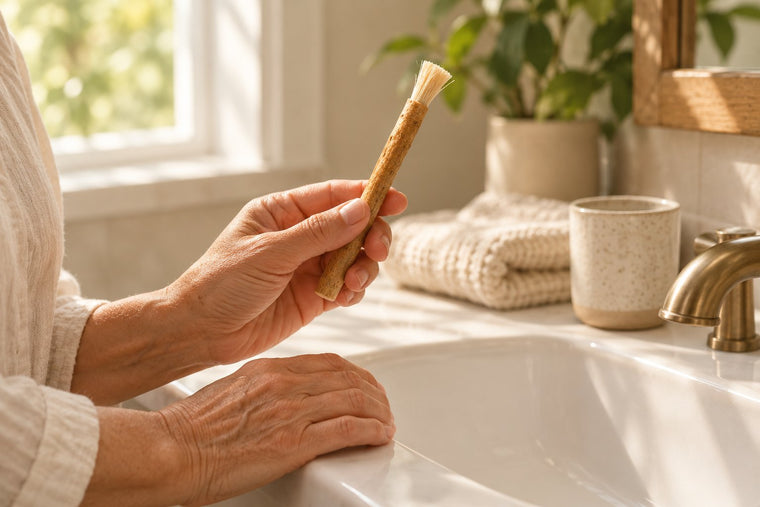
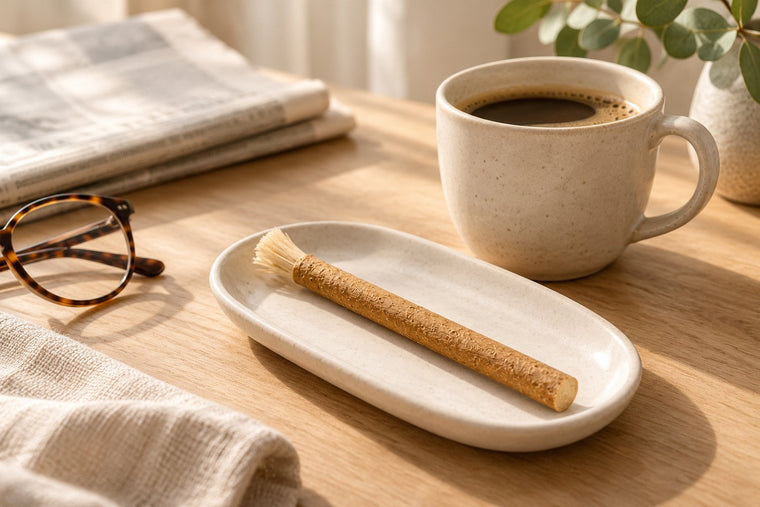
A miswak is a cleaning stick cut from the root of a small tree, Salvadora persica. People in many countries have cleaned their teeth with it for about 7,000 years, long before nylon existed. Nylon bristles only date from the late 1930s. You peel about half an inch of bark from one end, chew that end gently until the wood separates into fine, soft fibers, and brush with it. Every day or two you trim the used end and chew a new one. One stick lasts two to three weeks.
What that does to the count:
Eighteen sticks a year instead of four brushes. More items, which is a fair point. Each spent stick is a piece of wood about the size of a pencil stub, and it goes in the compost or the yard waste bin. It is a twig. The ground knows what to do with a twig.
Nothing to sort, nothing to mail. No bristles to pull out with pliers, no box in the closet.
One stick replaces the brush, the head, and the battery. There is no handle, no electronics, no charger.
The sleeve. Each stick comes vacuum-sealed in a thin plastic sleeve so it arrives clean. It is small, and it is plastic, and we would rather say so than have you find out at the sink.
There is a body of published research on Salvadora persica. We link the studies on our research page so you can read them yourself. Results vary, and a miswak is not a treatment.

What it's honestly like
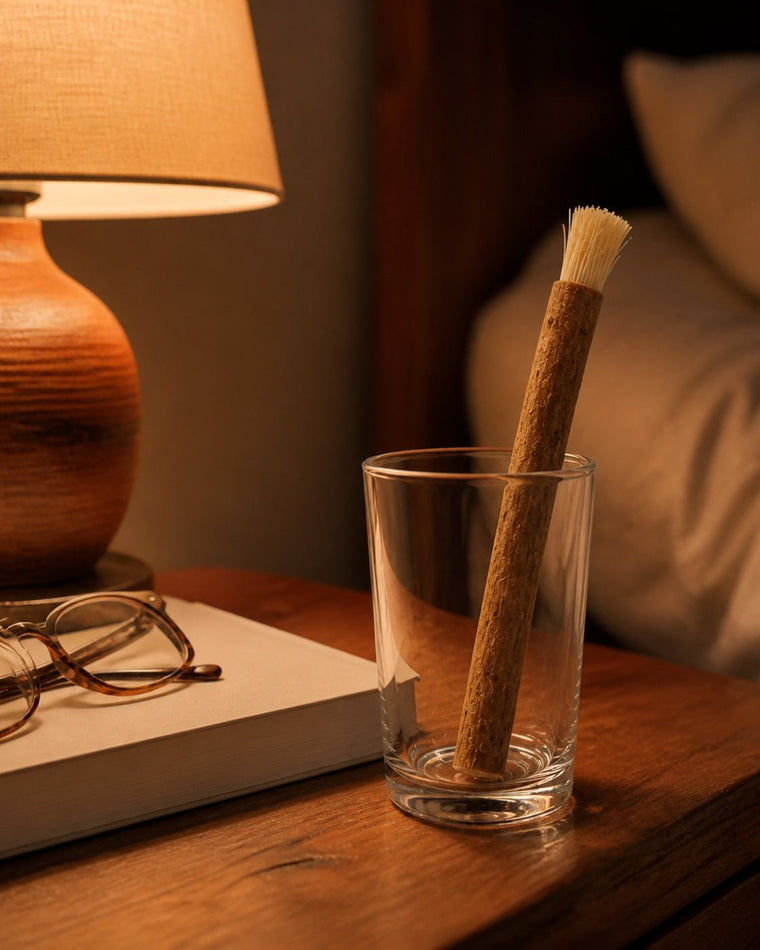
It is a twig, about as thick as a pencil and as long as your hand. You peel it, chew the end, and brush with the fibers. The first few days feel odd, because forty years of handles are hard to put down. By the end of the first week most people have stopped thinking about it. It works with or without toothpaste, and if your dentist has you on fluoride, you keep it. It is not a medicine, and it does not replace your dentist or your cleanings. It is a way to brush twice a day without adding another piece of plastic to the pile, and that is the whole promise.
This article is general information, not medical advice. A miswak is a cleaning tool, not a treatment. If your gums bleed regularly, hurt, or if a problem does not go away, please see your dentist.