Why dental bills explode after 60

You went in for a cleaning and came out with an estimate that has a comma in it. Maybe it was a crown on a back tooth that cracked on a popcorn kernel. Maybe the hygienist said "deep cleaning" and the front desk said a price per quarter of your mouth.
If this sounds familiar
- The estimate is in a kitchen drawer, and the work is not scheduled.
- You asked whether Medicare covers it and got a one-word answer.
- A filling from the 1980s became a bigger filling, then a crown, and now there is talk of a root canal under the crown.
- You have started putting off the six-month cleaning, because every visit ends with "we found something."
- You have wondered, quietly, whether it would be cheaper to just have it pulled.
If a few of those are yours, you are in the majority. This is what dental care looks like for most Americans past 60.
Why the bills climb after 60
Three things come together, and none of them is your fault.
Old work wears out. A filling is not built to last a lifetime. Most give out after a decade or two, and the fix is always bigger than the original: a larger filling, then a crown, then a root canal, then an implant. Every step costs more than the one before.
The gums get involved. After 50 the gumline pulls back and uncovers the roots, which have no enamel and decay faster than the top of the tooth. Plaque that has sat along the gumline for years turns into gum disease, which is billed as deep cleaning and then as maintenance visits. Many medications common after 60 dry the mouth, and teeth in a dry mouth decay faster.
Medicare does not pay for most of it. Original Medicare does not cover routine dental care. No cleanings, fillings, crowns, root canals or dentures. Some Medicare Advantage plans include a dental benefit, usually with a yearly cap that one crown can use up. For many people over 65, the big bills come out of pocket.
We will not quote exact prices, because they change by city and by office. A crown is a four-figure bill. A root canal is hundreds of dollars before the crown that goes on top. Deep cleaning is priced per quarter of the mouth, each quarter in the hundreds. An implant for one tooth runs to several thousand.
What most people try, and why it disappoints
- Waiting. Teeth do not get cheaper to fix by waiting. A small cavity becomes a crown. A cracked crown becomes a root canal.
- Having it pulled. Cheaper on the day. Then the teeth on either side lean into the gap, the one above drifts down, and chewing moves to the other side.
- Brushing harder, out of guilt. Exposed roots are the part that wears fastest, and a stiff brush pressed hard takes more of them.
If a tooth hurts, or if your gums bleed when you brush, please do not wait it out. The visit where the dentist finds something early is the cheapest visit you will ever have.
So what can you do?
The work on the estimate needs a dentist. There is no way around that. What you control is the slow part: the two minutes along the gumline, twice a day, where root decay and gum disease begin. Daily care costs very little. Repair costs a lot.
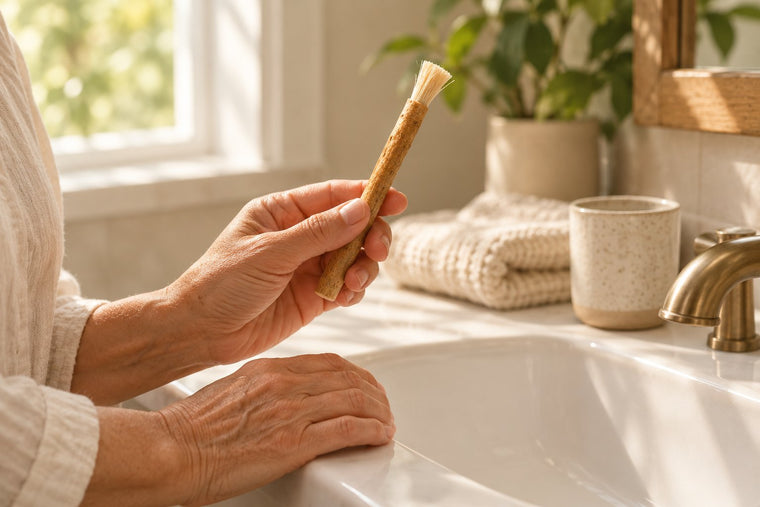
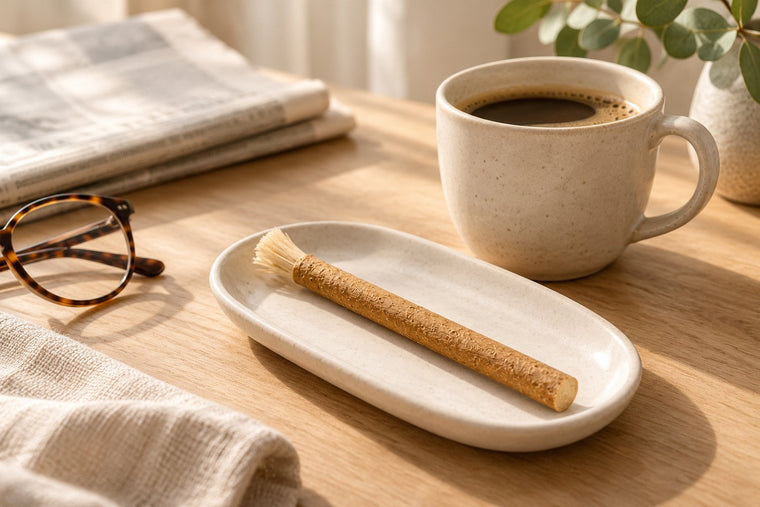
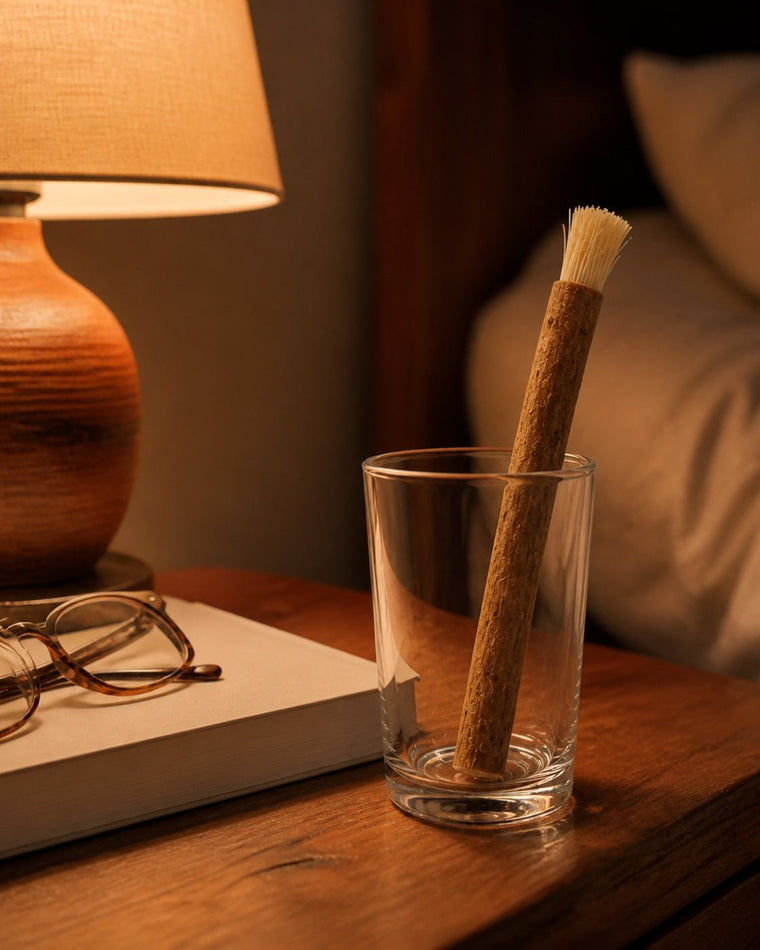
A miswak is a cleaning stick cut from the root of the Salvadora persica tree. People have cleaned their teeth with it for about 7,000 years, in many countries. You peel half an inch of bark from one end, chew that end gently until the wood splits into fine, soft fibers, and brush for about two minutes. Every day or two you trim the used end and chew a new one. One stick lasts two to three weeks.
Why it fits this problem:
It is gentle on the parts that cost the most. Exposed roots and a thinning gumline are where the expensive work starts. The fibers of a miswak bend, they are never cut to a point, and you are never brushing with worn, splayed bristles, because the worn part gets trimmed away. Held upright and moved away from the gum, it reaches the neck of each tooth without scraping it.
It costs about a dollar a week. The Family Pack is 18 sticks for $57.95. At two to three weeks per stick, that is roughly a year of brushing for one person, which comes to a little over a dollar a week. With the $6 shipping it is still well under a dollar and a half. There are no heads to buy and no batteries to replace.
There is nothing to forget. No charger, no head that should have been changed in March.
Now the sentence we owe you. We cannot promise that a stick will keep you out of the dentist's chair. Nobody honest can promise that about any brush. Teeth crack, old fillings fail, and some gum disease runs in families. What a gentle daily routine can do is make sure the part that is up to you actually gets done, without wearing down roots that are already out in the open.
There is a body of published research on Salvadora persica. We link the studies on our research page so you can read them yourself. Results vary, and a miswak is not a treatment.

What it's honestly like
It is a stick of root, about the thickness of a pencil and roughly as long as your hand, and it looks like a twig because it is one. For the first few days your hand will reach for a handle that is not there. Most people are used to it within a week. It is not a medicine. It does not fix a cracked tooth or an old filling, and it does not replace the cleaning where the hygienist checks your gums. Keep those appointments. What the stick does is make the cheap part of dental care, the daily part, gentler and simpler to keep up.
This article is general information, not medical advice. A miswak is a cleaning tool, not a treatment. If your gums bleed regularly, hurt, or if a problem does not go away, please see your dentist.