If your toothbrush turns pink, read this

There is a little pink in the sink when you spit, and the tips of your toothbrush are stained the same color. It has been like that for a while. Somewhere along the way you decided it was normal, because it seems to happen to everyone, and because the last time you mentioned it the answer was "floss more."
First, the line that matters most, and we will repeat it below: gums that bleed regularly need to be looked at by a dentist. Healthy gums generally do not bleed from gentle brushing. Please book the appointment. The rest of this article is about the part you do at home.
If this sounds familiar
- You rinse the brush under the tap and watch a little pink swirl down the drain.
- Some mornings there is a trace of blood on the pillowcase.
- You floss once, see blood, and put the floss back in the drawer for a month.
- Biting into an apple leaves a pink mark on the white part.
- You brush that one tender spot very lightly, or skip it.
- The hygienist said "some bleeding on probing" and handed you a pamphlet.
If you nodded at a few of those, you are not alone, and you are not careless. Bleeding at the gumline is one of the most common things dentists see.
Why this happens more after 50
Gums bleed when the thin edge along the tooth is irritated. The most common reason is a soft film of plaque sitting at the gumline and between the teeth. The gum reacts, gets puffy, and bleeds at the lightest touch. That is also why "floss more" is the standard answer. It is about getting the film off the edge.
After 50 a few things pile up, and none of them is your fault.
Hormones. When estrogen drops during and after menopause, gum tissue becomes thinner and reacts more strongly to the same amount of plaque.
The gumline moves. Gums pull back over the years and open small gaps where film collects. A brush that cleaned the edge fine at 35 misses it at 60.
Medicines. Some common ones, including blood thinners, make gums bleed more easily, and some blood pressure medicines make them swell. Tell your dentist everything you take.
Decades of scrubbing. Forty years of hard, sideways brushing with stiff bristles leaves the gum edge worn and easily irritated. Frayed nylon tips, kept far too long, scrape it further.
What most people try, and why it disappoints
- Brushing harder. It feels like cleaning it out. It irritates the edge more, and it bleeds more.
- Brushing lighter, or skipping the spot. Understandable, and it leaves the film exactly where it causes the trouble. Dentists generally say the opposite: keep cleaning the gumline, gently, every day, even if it bleeds at first.
- Mouthwash. Many contain alcohol, which stings an irritated gum, and rinsing does not lift film off the edge.
- A new electric brush. Some people do well with one. Others find the vibration on an irritated gumline too much.
So what can you do?
Two things, in this order. See your dentist, so someone can look at what is causing it. Then change the tool that touches that gum edge twice a day, so the daily cleaning is gentle enough to keep doing.
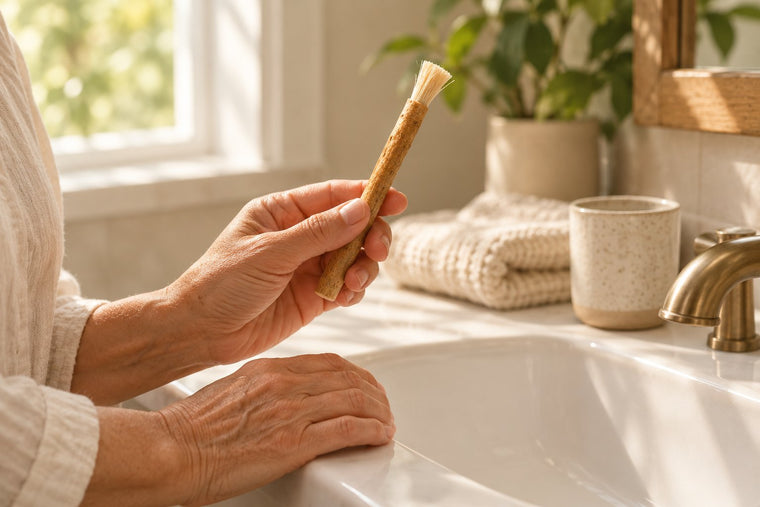
A miswak is a cleaning stick cut from the root of a small tree called Salvadora persica. People have cleaned their teeth with it for about 7,000 years, in many countries. You peel about half an inch of bark from one end, chew the tip gently until the wood separates into soft fibers, and brush for about two minutes, holding the stick upright and moving it up and down, away from the gum.
Here is why that suits an irritated gumline:
The fibers are soft and natural. They are not cut to a sharp point the way nylon is. They bend. Held upright and moved up and down, they reach the edge of the gum and into the small gaps without the scraping that worn bristles do.
A new tip every day or two. You cut off the used end and chew a new one. You are never brushing an irritated gum with bristles that have been fraying for months.
Up and down, away from the gum. The stick is shaped for the motion dentists usually ask for and most of us never learned: upright, along the tooth, from the gum outward. Sideways scrubbing is hard to do with a stick, which is the point.
With or without toothpaste. If your dentist wants you on a fluoride paste, keep it. If foam on a sore gum bothers you, you can brush with the stick alone.
There is a body of published research on Salvadora persica. We link the studies on our research page so you can read them yourself. Results vary, and a miswak is not a treatment.
To be plain about what we claim: the stick changes how the gum edge is touched. We cannot promise what your gums will do. If the pink keeps showing up after a few weeks of gentle daily cleaning, that is something to show your dentist. Brushing harder will not help.

What it's honestly like
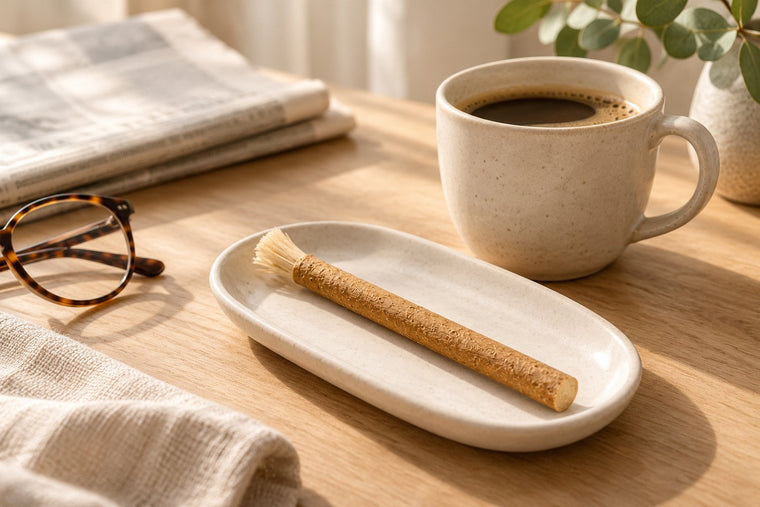
It is a stick. It looks like a twig because it is one, about as thick as a pencil and four to six inches long. The first few days feel odd, mostly because you are used to a handle and a head. By the end of the first week most people stop noticing. You trim the tip every day or two and open a new stick every two to three weeks. It is not a medicine, and it is not a substitute for the appointment. Gums that bleed regularly, gums that hurt, or a tooth that feels loose need a dentist. What the stick can do is make the two minutes at the gumline, morning and night, gentle enough that you keep doing them.
This article is general information, not medical advice. A miswak is a cleaning tool, not a treatment. If your gums bleed regularly, hurt, or if a problem does not go away, please see your dentist.