The morning breath that doesn't leave after breakfast

You brush in the morning, you have your coffee, and by ten o'clock your mouth already feels stale again. There is gum in your purse and a tin of mints in the car. You have caught yourself turning your head a little when someone stands close. Nobody has said a word, and somehow that makes it worse.
If this sounds familiar
- The first thing you reach for after lunch is a mint, before you even think about it.
- Your mouth feels dry and sticky by mid-morning, even though you brushed.
- Mouthwash helps for about as long as the drive to the store.
- You drink coffee all day, and by three o'clock your mouth feels like paper.
- You brush extra hard at night, hoping tomorrow will be different.
- At the dentist you heard "a little buildup along the gumline" and nothing more.
If you nodded at a few of those, you are far from alone. Breath that comes back an hour after brushing is one of the quietest worries people carry around, and most people think they just need to try harder.
Why this happens more after 50
The smell itself comes from a simple place. Bacteria live in the soft film that collects along the gumline, between the teeth and on the back of the tongue. When that film sits for hours, it starts to smell. Brushing clears some of it in the morning, and then it builds again all day.
Two things make this worse after 50, and neither one is your fault.
The mouth gets drier. Saliva is the mouth's own rinse. It washes food and film off the teeth all day long. After menopause many women make less of it, and so do many common medicines, including blood pressure pills, antihistamines and antidepressants. Coffee and a dry, heated house add to it. In a dry mouth the film sits longer and smells sooner.
The gumline changes. Over the years the gums pull back a little, and small gaps open along the edge of the tooth and between the teeth. Those gaps hold food and film that a quick morning brush never reaches. That is the "buildup" the hygienist mentioned.
What most people try, and why it disappoints
- Gum and mints. They cover the smell for about twenty minutes, and the sugar in many of them feeds the same film you are trying to get rid of. Sugar-free gum does get saliva going, which helps. The smell underneath is still there.
- Mouthwash. Many of the strong ones contain a lot of alcohol. Alcohol dries the mouth, and a dry mouth is where the smell started. It covers for a while and then hands the problem right back.
- Brushing harder. Scrubbing irritates the gumline and does nothing about the hours in between.
- A stronger toothpaste. It changes how your mouth feels for a few minutes. The film comes back on the same schedule.
So what can you do?
A mouth that gets dirty all day needs a little attention during the day, with a tool you can use without a sink.
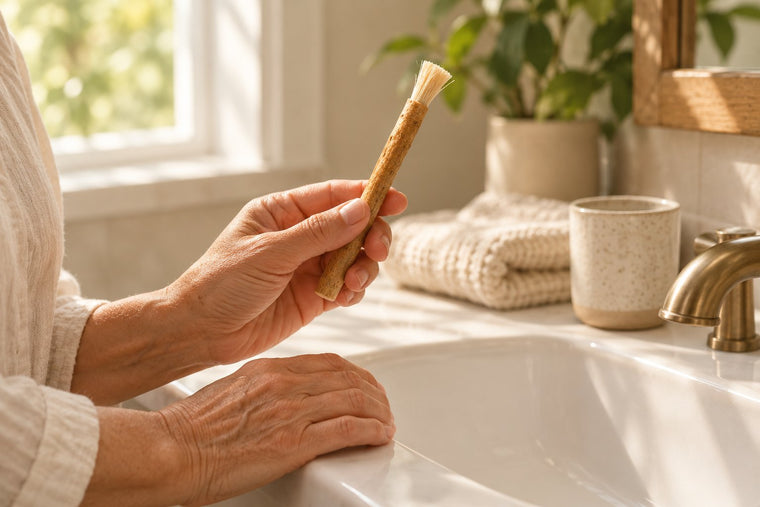
A miswak is a cleaning stick cut from the root of a small tree called Salvadora persica. People in dozens of countries have cleaned their teeth with it for around 7,000 years. You peel about half an inch of bark from one end, chew the tip gently until the wood separates into soft fibers, and brush with those fibers for about two minutes, holding the stick upright and moving it up and down, away from the gum.
Here is why that fits this particular problem:
It goes where you go. It lives in your purse or the cup holder, each stick sealed in a thin plastic sleeve until you open it. You do not need a sink, and you can use it with or without toothpaste. After the morning coffee, after lunch at your desk, in the car before you go in somewhere (parked, never while driving), you take it out and spend a minute along the gumline. That is the cleaning the film never used to get.
Chewing gets saliva going. Preparing the tip means chewing it, and chewing is one of the oldest ways to make the mouth water. Doing that three or four times a day gives a dry mouth its own rinse back, for a while, each time.
The fibers reach the gumline gently. They are soft and a little uneven, and they bend into the edge where the film collects without scraping the gum. You trim the tip every day or two, so you are never brushing with worn bristles.
There is a body of published research on Salvadora persica. We link the studies on our research page so you can read them yourself. Results vary, and a miswak is not a treatment.

One more thing, and it matters. Breath that does not go away, no matter what you do, can have causes that have nothing to do with a toothbrush: gum disease, sinus trouble, reflux, a medicine that dries the mouth, or something else. If yours has stayed for weeks, talk to your dentist or doctor. They can look for what a stick cannot.
What it's honestly like
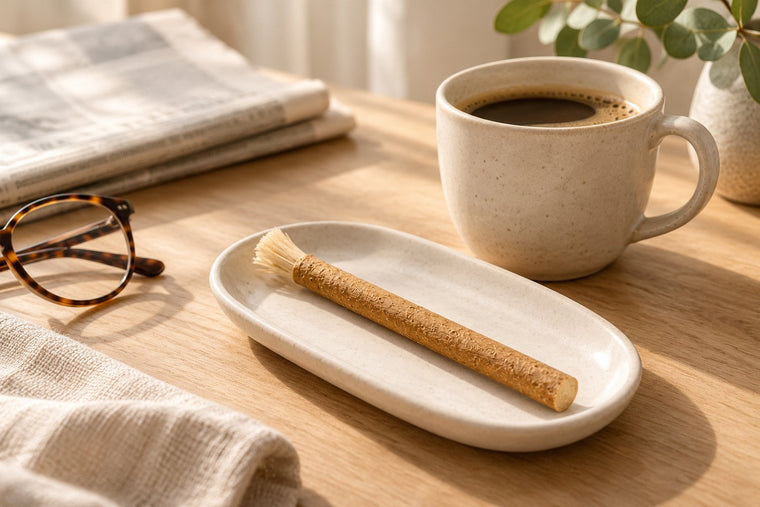
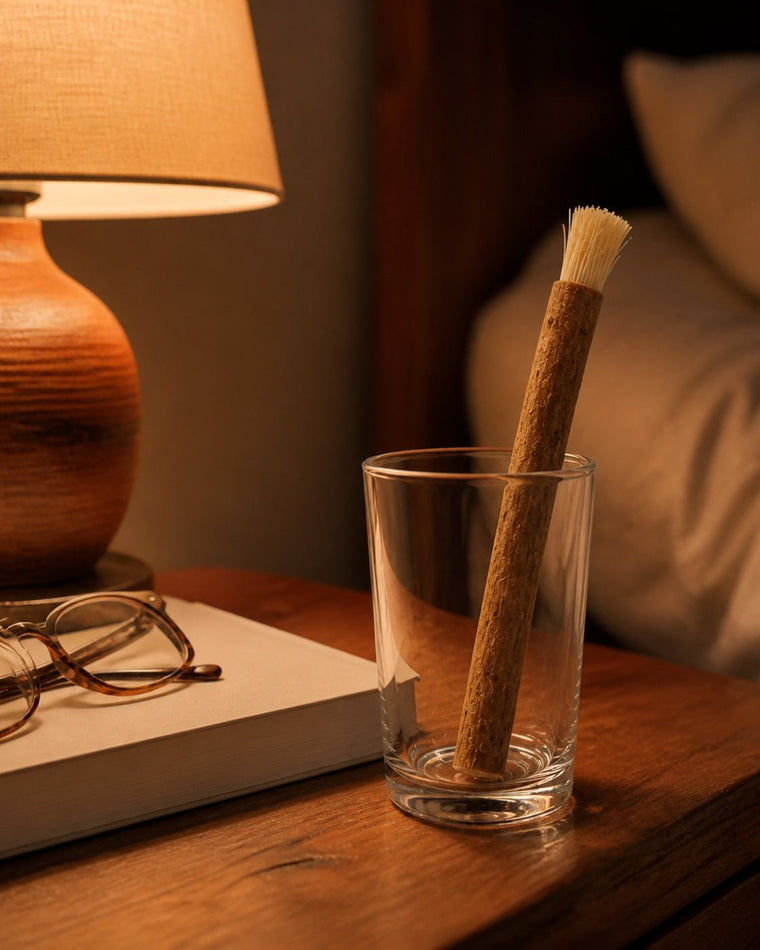
It is a stick. It looks like a twig because it is one, about as thick as a pencil and four to six inches long. The first few days feel strange, mostly because you are used to a handle. By the end of the week most people simply reach for it. It needs a little trimming every day or two and a new stick every two to three weeks. Loose fibers can come off while you chew, so spit them out, and use it sitting or standing, never lying down or walking. It is not a medicine, and it will not replace a dental cleaning. It is a simpler way to clean the gumline more often than twice a day.
This article is general information, not medical advice. A miswak is a cleaning tool, not a treatment. If your gums bleed regularly, hurt, or if a problem does not go away, please see your dentist.