Long in the tooth: the gumline nobody warned you about

Your teeth look longer than they used to, and you are not imagining it. Maybe you felt it with your tongue, a small ridge near the gum that was not there a few years ago. Maybe you noticed it at the table, when a piece of chicken wedged between two back teeth and stayed there through dessert.
If this sounds familiar
- Food gets caught between the same two teeth at almost every meal, and there is a toothpick in your purse for it.
- There are small dark gaps between your front teeth, right at the gumline, that are not in your older photos.
- You can feel a little step with your tongue where the smooth part of a tooth ends and something rougher begins.
- A sip of cold water hits one tooth hard.
- At your last cleaning, the hygienist called out numbers to an assistant, and nobody explained them.
If two or three of those made you nod, you are in a very large group. The saying "long in the tooth" comes from horses. Their gums pull back with age and the teeth look longer. It happens to people too, and past 50 it happens to most of us.
Why this happens more after 50
The gum is a collar of tissue around each tooth. Over the years, that collar slides down a little and uncovers the root. The root has no enamel. It is softer, a shade darker, and it was never meant to be out in the open. Between the teeth, the small point of gum that fills each gap shrinks too, and the empty triangle it leaves is where food goes.
Several things push it along, and none of them is your fault.
Decades of scrubbing. Most of us were taught to brush side to side with a brush that was a little too stiff. The gum edge is thin, and forty years of that wears it down.
Plaque at the gumline. When plaque sits along the edge of the gum for a long time, the gum gets irritated, and irritated gum slowly lets go of the tooth.
Thinner tissue. Gum tissue gets thinner with age, the way skin does. After menopause, lower estrogen makes it thinner and drier still.
Now the hard part, because nobody tells you plainly: gum that has pulled back does not grow back on its own. For severe cases there are gum grafts, which a periodontist can explain. For the rest of us, the job is to keep what we have and to be kinder to it from here on.
What most people try, and why it disappoints
- Brushing harder at the gumline. The gaps look grubby, so you scrub them. This is the one habit that most reliably makes recession worse. The root is soft, and a stiff bristle takes a little more of it, and of the gum, every day.
- Gritty toothpaste for stains. The exposed root stains easily, so harsh pastes are tempting. They are made to polish enamel, and the root has none.
- Toothpicks. They get the chicken out. Jammed into the same gap every day, a wooden point nudges the gum a little further back.
- Mouthwash. It rinses, and that is about all. It cannot lift what is packed into a gap.
- Leaving it alone. Most days it does not hurt. Food that sits in a gap for days keeps the gum there sore, and sore gum keeps moving.
If a gap traps food at every meal, or if the gum beside it is red or bleeds, please have your dentist look at it.
So what can you do?
Two things, and both are small. Clean along the gumline every day. Do it gently enough that you could keep doing it for another thirty years.
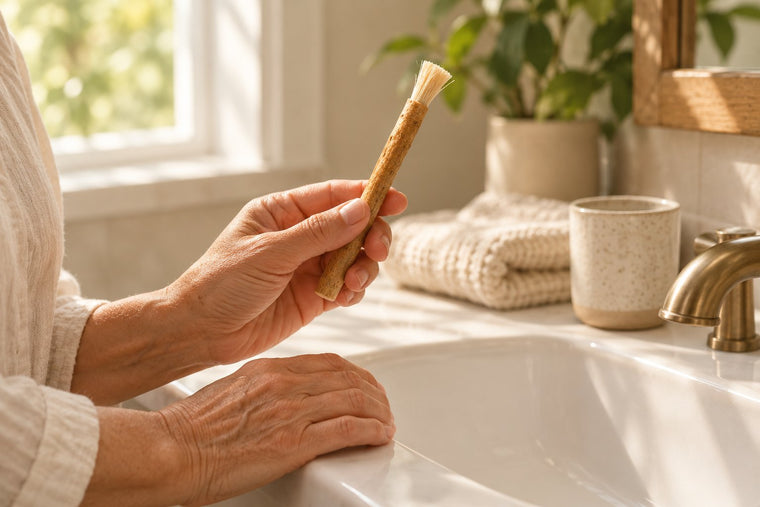
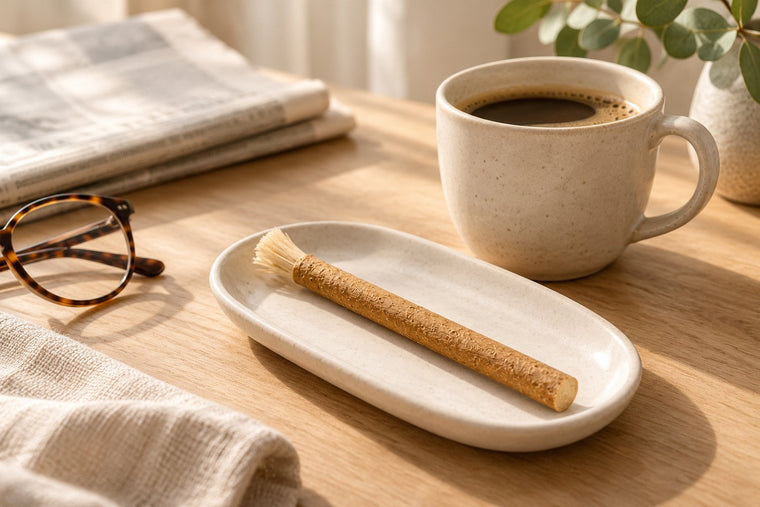
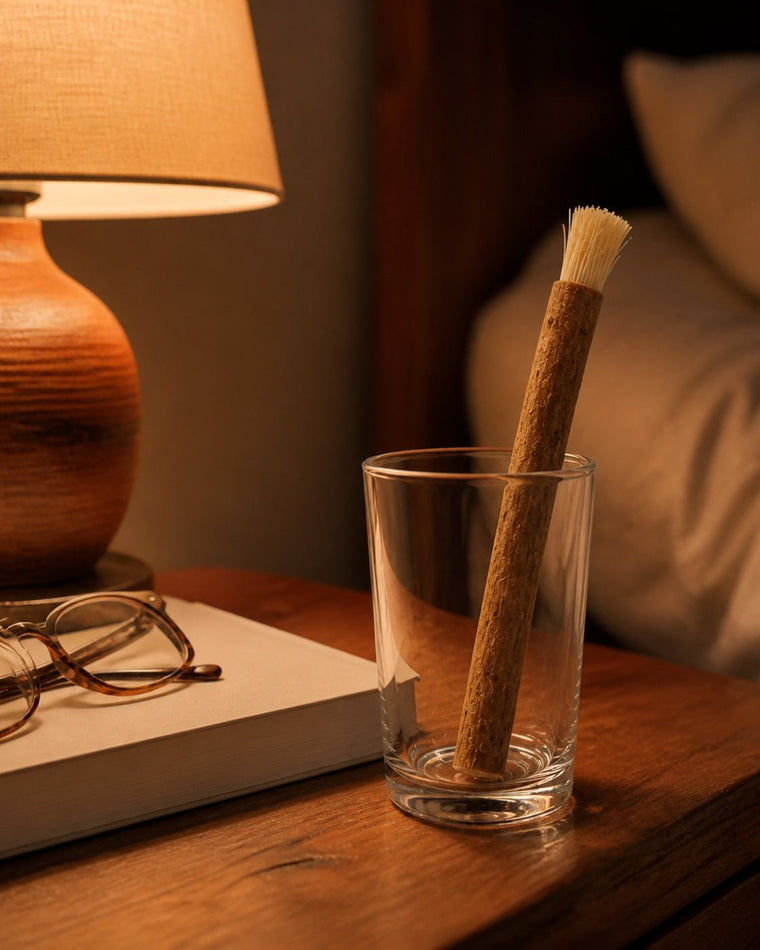
A miswak is a cleaning stick cut from the root of a small tree, Salvadora persica. People in many countries have cleaned their teeth with it for about 7,000 years. You peel about half an inch of bark from one end, chew that end gently until the wood separates into fine, soft fibers, and brush with those fibers.
Here is why that suits a gumline that has moved:
The tip is small. The working end is about as wide as a pencil. It fits along the neck of each tooth, where a wide brush head tends to skate past. Hold the stick upright and move it up and down, from the gum toward the biting edge, and the fibers follow the curve of the tooth.
The fibers are soft. They were never cut to a point. They bend. You cannot really scrub with a miswak, and for a receding gumline that is a good thing.
You are never using worn bristles. Every day or two you trim off the used end and chew a new one. Worn, splayed nylon is what scrapes a root. With a stick there is no such thing as an old brush.
Keep doing whatever your dentist asked you to do between the teeth. A miswak does not replace floss or the little brushes made for the gaps.
There is a body of published research on Salvadora persica. We link the studies on our research page so you can read them yourself. Results vary, and a miswak is not a treatment.

What it's honestly like
It is a piece of root. It looks like something you would pick up on a walk, about as thick as a pencil and about as long as your hand. The first few days feel odd, because there is no handle and no head. Most people are used to it within a week. One stick lasts two to three weeks. It will not move your gumline back. Nothing in a store does that. It is not a medicine, and it does not replace the dentist who measures those gums. What it offers is a gentler way to do the daily cleaning on a gumline that has become easy to hurt.
This article is general information, not medical advice. A miswak is a cleaning tool, not a treatment. If your gums bleed regularly, hurt, or if a problem does not go away, please see your dentist.