If you take blood pressure pills, your mouth has changed

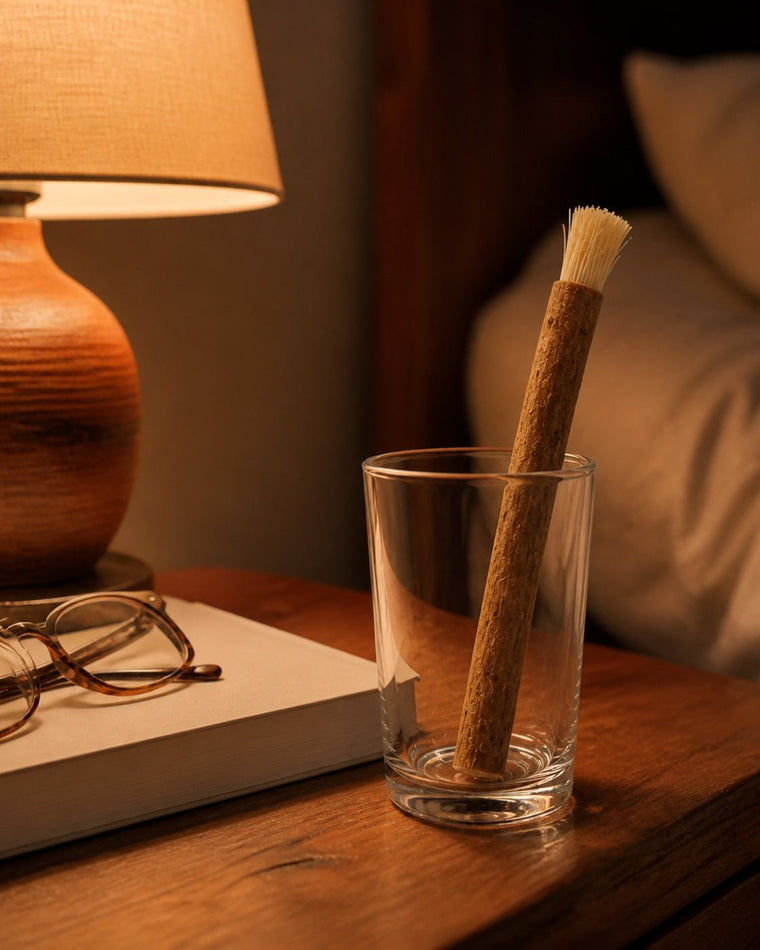
Since you started the pills, your mouth has been dry, and nobody at the doctor's office mentioned that this would happen. There is a glass of water on the nightstand now. You wake at three in the morning with your tongue stuck to the roof of your mouth. Crackers feel like sand. You have started to wonder whether it is the pills, or just age, or something you are doing wrong.
If this sounds familiar
- You wake up at night to drink, and the glass is empty by morning.
- Your lips stick to your teeth when you talk for a while.
- Dry food, like toast or a cracker, is hard to swallow without a sip of something.
- Your gums feel tender for no reason you can point to.
- You had more cavities at your last two checkups than in the twenty years before.
- The pharmacy sheet said "may cause dry mouth," and you thought it would pass. It did not.
If you nodded at several of those, you are in very good company. Dry mouth is one of the most common side effects of the medicines people take after 50, and one of the least talked about, because it never feels serious enough to bring up. It is worth bringing up.
Why this happens more after 50
Saliva does a lot of quiet work. It washes food and film off the teeth, it keeps the gums comfortable, and it helps protect the enamel. When there is less of it, the mouth gets sticky, the gumline collects more film, and dentists see more cavities right at the edge of the gum, especially in older adults.
Many medicines reduce saliva as a side effect. The common ones include blood pressure medicines, especially water pills; antihistamines for allergies; many antidepressants; medicines for an overactive bladder; and some pain and sleep medicines. Taking two or three of them at once, which is normal after 60, adds the effect up.
On top of the pills, menopause dries the mouth on its own, and a heated bedroom in winter adds to it. None of this is your fault, and you are not alone with it.
One thing we want to say clearly, because it matters more than anything else here: do not stop or change your medication because of a dry mouth. Those pills are doing a job. If the dryness bothers you, talk to your doctor or pharmacist. Sometimes they can adjust the timing or the dose. That is their decision, made with you.
What most people try, and why it disappoints
- Water. It helps for a minute, which is why the glass is on the nightstand. Water wets the mouth. It does not do what saliva does.
- Mints and hard candy. Sucking does get a little saliva going. Most of them are sugar, and sugar in a dry mouth is how those new cavities got started.
- Sugar-free gum. Better than candy. For some people the jaw tires, or it does not get along with a partial.
- Mouthwash. Many contain alcohol, which dries the mouth further. It feels like something for a moment and leaves the mouth drier afterward.
- A foaming toothpaste. The foaming agent in many pastes can sting a dry mouth and tender gums.
- Brushing harder. Dry gums are tender gums. Scrubbing makes them sore.
So what can you do?
The part of this you can change is what you clean with and how often, because a dry mouth needs a little help more than twice a day.
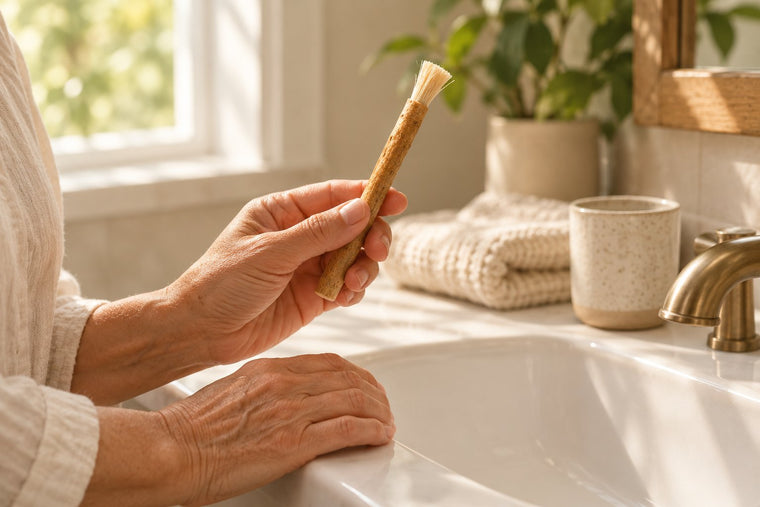
A miswak is a cleaning stick cut from the root of a small tree called Salvadora persica. People have cleaned their teeth with it for about 7,000 years, in many countries, with no handle, no battery and no plastic. You peel about half an inch of bark from one end, chew the tip gently until the wood separates into soft fibers, and brush for about two minutes with the stick upright, moving it up and down, away from the gum.
Here is why it fits a dry mouth in particular:
Chewing gets saliva going. This is the heart of it. To prepare the tip you chew it, and chewing is one of the most reliable ways to make the mouth water. Every time you prepare the tip, your mouth gets a little of its own rinse back.
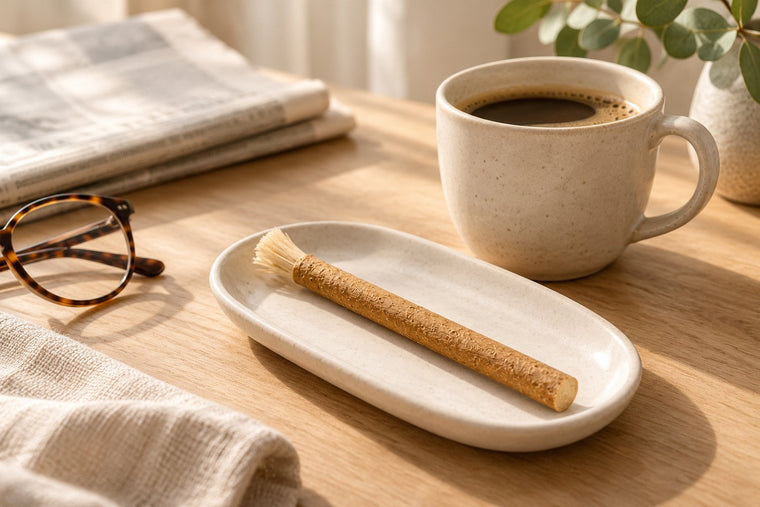
You can use it several times a day, anywhere. The stick lives in your purse or on your desk. After coffee, after lunch, in the car while it is parked, a minute along the gumline. You do not need a sink, and you can use it with or without toothpaste.
The fibers are soft. Dry gums are tender gums. The natural fibers bend along the gumline instead of scraping it, and because you trim the tip every day or two, you are never brushing with worn bristles.
It works alongside fluoride. Dry mouth is one of the main reasons a dentist will put you on a fluoride toothpaste or rinse. Keep using it. The stick replaces the brush, and nothing else.
There is a body of published research on Salvadora persica. We link the studies on our research page so you can read them yourself. Results vary, and a miswak is not a treatment.

What it's honestly like
It is a stick. It looks like a twig because it is one, about as thick as a pencil and four to six inches long. It comes sealed in a thin plastic sleeve, and the stick itself is wood that can go in the compost. The first few days feel odd, mostly because there is no handle. After a week most people stop thinking about it. You trim the used tip every day or two and open a new stick every two to three weeks. It is not a medicine. It will not make your mouth produce saliva the way it did at 40, and it will not replace your dentist or your doctor. If the dryness is severe, if swallowing is hard, or if you keep getting new cavities, please tell both of them. The stick is for the everyday part, done more gently and more often.
This article is general information, not medical advice. A miswak is a cleaning tool, not a treatment. If your gums bleed regularly, hurt, or if a problem does not go away, please see your dentist.