What the first 30 days with a miswak are really like

You have looked at the miswak page a few times now, and before you spend $13.95 on three sticks you would like to know what you are actually getting into. We sell them, so read this knowing that. We would still rather you know what the month looks like than be surprised on day two.
If this sounds familiar
- You have ordered things from a Facebook ad before, and a few of them went straight into the drawer under the sink.
- The reviews say it takes some getting used to, and nobody explains what that means.
- You have a hard time picturing how a piece of wood is supposed to clean your teeth.
- You are willing to try something new, as long as it does not make you feel foolish.
- You would like to know what day one and day ten look like, and when you can decide whether it suits you.
Here is the month, in order.
Day 1: the box arrives
Each stick comes sealed in its own sleeve. The stick is wood and compostable. The sleeve is a thin plastic film, and we say so plainly.
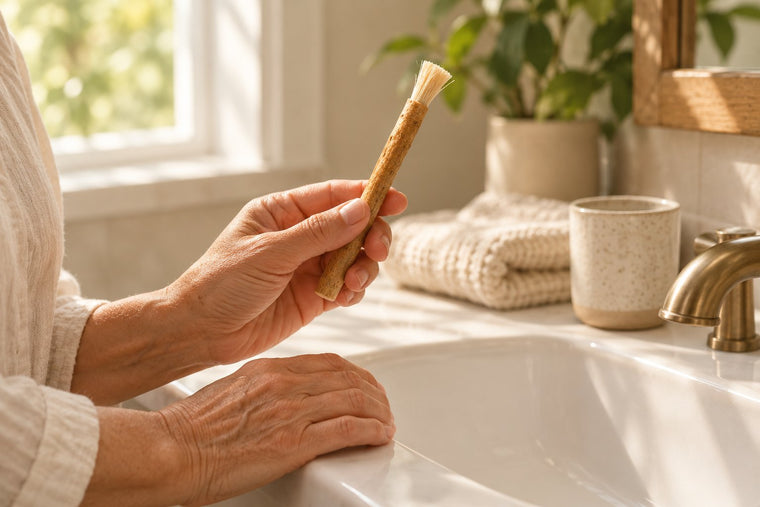
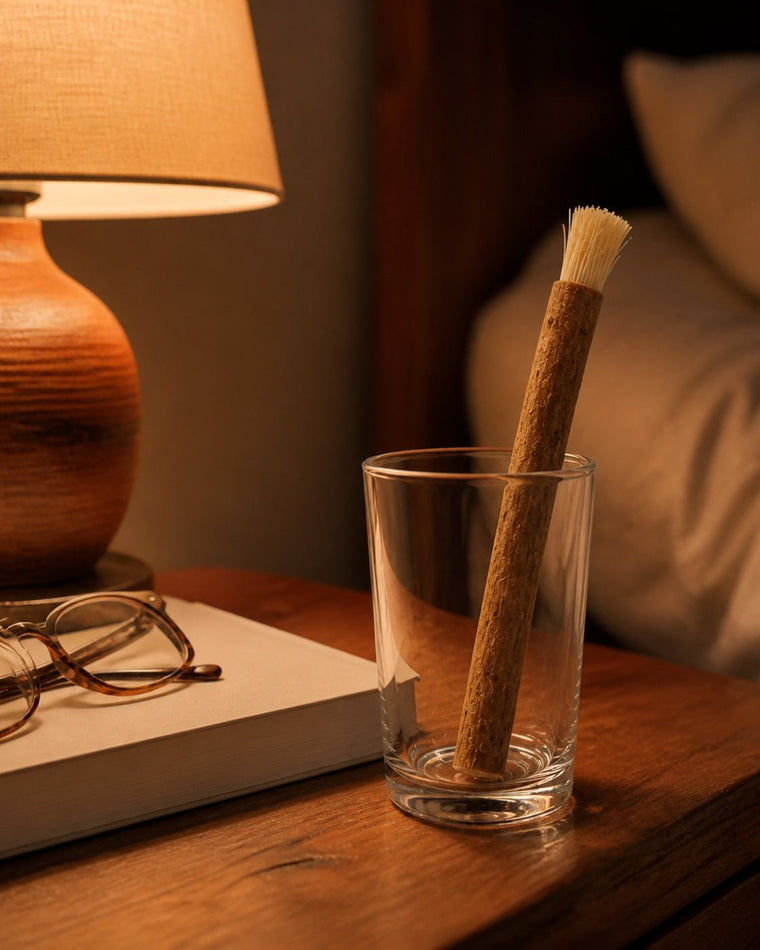
The first surprise is the size. It is thinner than it looks in photos, about as thick as a pencil, and roughly as long as your hand. It is brown, a little rough, and it looks like a twig from the yard. That reaction is correct.
Peel about half an inch of bark from one end. A fingernail works, and so does a small knife. Then chew the bare end gently. The wood is firm at first, and chewing on it feels strange. You will wonder if you are doing it right. After a minute or so the fibers begin to separate, and the end looks like a small, soft brush. That is the moment it makes sense.
Hold the stick upright and move it up and down along each tooth, away from the gum. Two minutes, the same as always. Use toothpaste if you like. If your dentist wants you on fluoride, keep it. On day one you will probably brush too fast and hold the stick three different ways. Everyone does.
Days 2 and 3: the awkward part
Your hand still does not know where to go. The grip that felt fine yesterday feels wrong today. This is the part the reviews mean.
Some fibers will come loose and end up on your tongue. Spit them out. Do not swallow them, and do all of this sitting or standing, never lying down or walking around. Our use-and-safety page covers this, and it is worth reading once.
The tip looks a bit ragged by now. That is normal. If it gets too soft or too splayed, cut off the used end, about a quarter inch, and chew a new one. Your old toothbrush is probably still on the counter. Leave it there. Nobody is grading you.
Week 1: a routine shows up
Somewhere around day five, your hand stops thinking. The stick goes in, up and down, done. Trimming the tip every day or two becomes a small habit, like changing a razor blade. Brushing takes about as long as it did before.
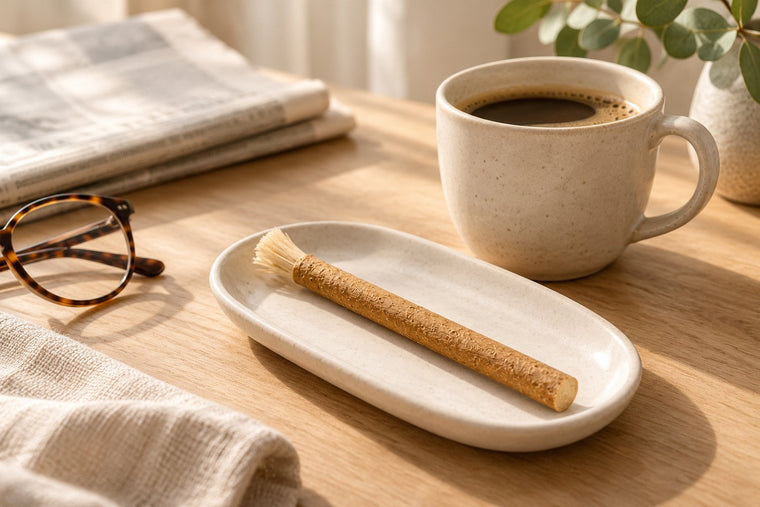
This is also when the stick tends to leave the bathroom. It ends up in a purse, on a desk, or next to the coffee maker, because it does not need a sink.
Week 2: you forget the old brush
The plastic brush is still by the sink, and you notice you have not touched it in days. This is a good time to ask yourself whether the stick suits you. By now you know how the fibers feel on your gums and whether the two minutes feel easier or harder than they used to.
The stick is noticeably shorter, because you have been trimming it.
Week 3: the stick runs out
Somewhere between day 14 and day 21 the stick is too short to hold comfortably. Open the next one. Peel, chew, brush. The step that took five fumbling minutes on day one takes thirty seconds now.
At day 30 you are on your second stick, maybe starting the third. That is why the Starter Pack has three in it.

What does not happen
There is no miracle in week two. Your teeth will not change color. Your gums will not be transformed. A miswak is a cleaning tool, and what it does is clean, twice a day, with soft natural fibers instead of plastic ones. If you were hoping for a dramatic before-and-after, this is the wrong product.
There is a body of published research on Salvadora persica. We link the studies on our research page so you can read them yourself. Results vary, and a miswak is not a treatment.
When to stop and call your dentist
If your gums bleed regularly, if a spot hurts, if a tooth feels loose, or if a sore in your mouth does not go away, stop and see your dentist. The stick does not fix any of that. If anything feels worse after the first week, do not push through it. Ask.
Who it is not for
- If you need foam to feel done. You can use toothpaste with the stick, but if the suds are the point for you, you will miss them.
- If you have very loose teeth, recent dental surgery, or an open sore in your mouth. Ask your dentist before you chew on anything.
- Children under three. Never. Older children only with an adult watching, because of the loose fibers.
- If you want to brush while walking around the house or lying in bed. The stick is for sitting or standing still, every time.
The honest summary
It is a twig. It is thin. The first three days feel odd, the first week feels manageable, and by the third week it is simply how you brush. It is not a medicine, and it does not replace your dentist. It is a simpler, gentler way to do the two minutes you were going to do anyway.
This article is general information, not medical advice. A miswak is a cleaning tool, not a treatment. If your gums bleed regularly, hurt, or if a problem does not go away, please see your dentist.