There's plastic in your mouth right now

Twice a day, for as long as you can remember, you have put a piece of plastic in your mouth and rubbed it against your teeth. The handle is plastic. The bristles are nylon, which is plastic too. And a brush that has been in use for a few months is missing some of it.
If this sounds familiar
- The bristles on your brush lean outward like an old broom, and you use it anyway.
- You cannot remember when you opened this one. Spring, maybe.
- When you run your thumb over the bristles, they feel short and blunt compared to the day you bought it.
- Every so often a whole bristle comes loose and sits in the sink.
- There is a pack of three in the hall closet, bought on sale, because this keeps happening.
- You have never once thought about where the worn-off part went.
We had not thought about it either, until we laid a new brush next to an old one and looked.
Three months in the life of a toothbrush
Day 1. Out of the package, the bristles stand straight. Each tip was rounded at the factory so it would not scratch. The brush feels soft against the gum.
Week 4. The outer rows have begun to lean outward. The tips are no longer round. Under a magnifying glass they look split and frayed. You do not notice this. Your hand does, and you press a little harder to get the same feeling of clean.
Month 3. The bristles are shorter and blunt. The head looks like a tiny worn-out broom. This is when the usual advice says to replace it. The advice is about cleaning power. Nobody mentions the material that is no longer on the brush.
So where did it go?
There are only two places it can go. Down the drain with the rinse water, or down your throat with the foam. We are not going to give you a count of particles, because nobody has an honest one for your bathroom. The plain fact is enough. Nylon does not dissolve. It wears off in pieces too small to see, and those pieces leave the brush while it is in your mouth.
Why this matters more after 50
Your gums have pulled back. The gumline moves over the decades and uncovers the root of each tooth, which has no enamel. Worn, split bristle tips rub that root twice a day. The brush that felt soft at 35 feels harsh at 60, and the harshness is the plastic wearing down.
You press harder than you used to. As the bristles dull, most people compensate without noticing. More pressure means more wear on the bristles and more wear on the gums.
You have been doing this for a long time. At four brushes a year, you have worn down well over a hundred of them by now.
If your gums bleed when you brush, with any brush, please tell your dentist.
What most people try, and why it disappoints
- Replacing the brush more often. Newer bristles are kinder to the gums, and that is a real benefit. The brush still wears from the first day, and now there are twice as many in the trash.
- A bamboo brush. The handle is bamboo. The bristles are almost always nylon. The part that wears off in your mouth is the same.
- An electric brush. The head is a smaller nylon brush that moves faster. It wears faster too, which is why the heads are sold in packs.
- Not thinking about it. Fair enough. It is a toothbrush. Once you have seen the two brushes side by side, though, it is hard to unsee.
So what can you do?
Use a brush that has nothing on it to wear off.
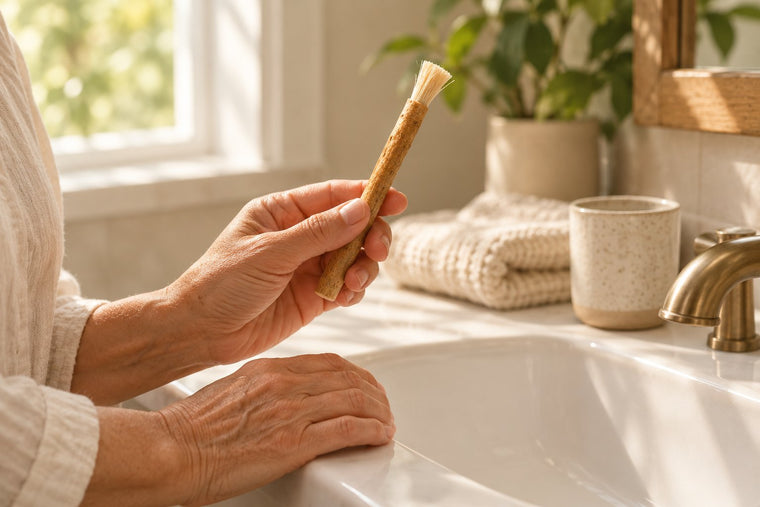
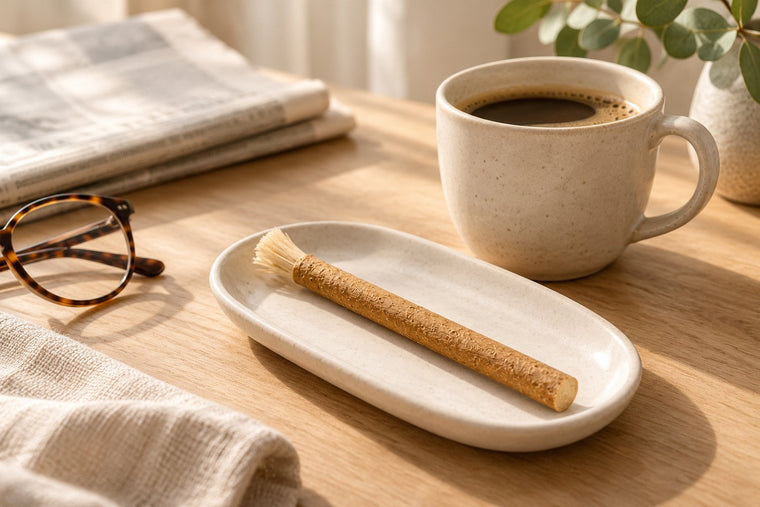
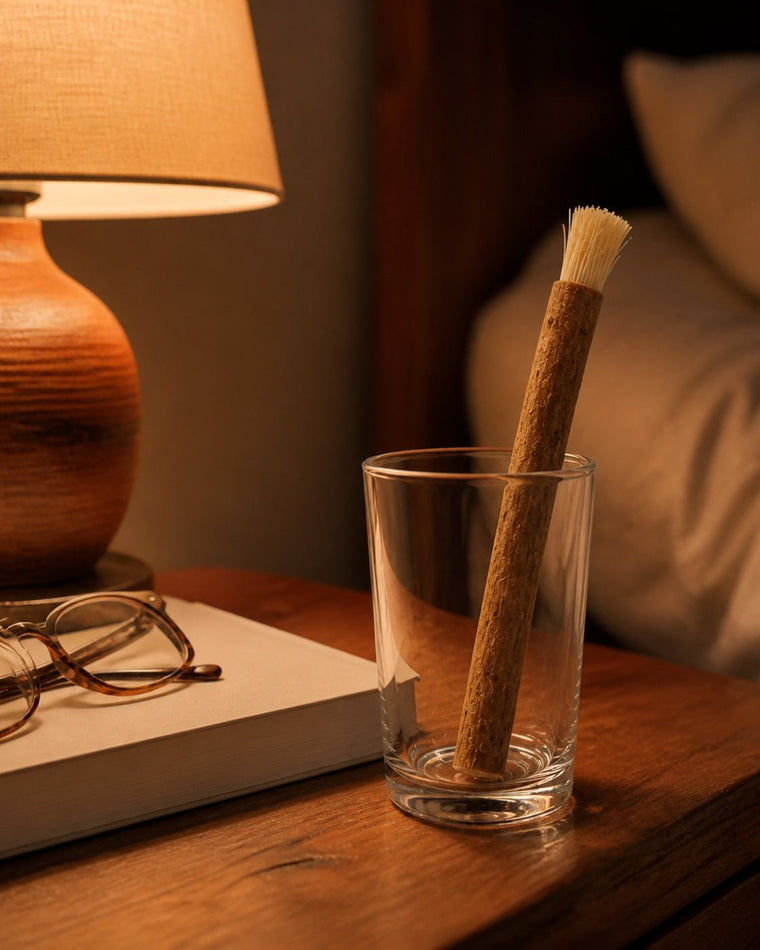
A miswak is a cleaning stick cut from the root of a small tree, Salvadora persica. People have cleaned their teeth with it for about 7,000 years, in many countries, long before nylon existed. You peel about half an inch of bark from one end and chew the tip gently until the wood separates into fine, soft fibers. Those fibers are the brush. They are the root's own fibers. Nothing was glued in.
Why that answers this one problem:
Zero bristles. What wears off a miswak is wood. You will feel a loose fiber now and then, and you spit it out. There is nothing synthetic on the stick, and nothing synthetic leaves it.
The worn part gets cut off. Every day or two you trim the used end and chew a new one. The end you use today is a day or two old at most, never splayed and blunt.
It goes back to the ground. When a stick is used up, after two to three weeks, it goes in the compost or the yard waste. It is a piece of root.
The one piece of plastic, said plainly. Each stick comes vacuum-sealed in a thin plastic sleeve, so it reaches you clean. This article is about plastic, so we will not hide that. The sleeve stays on the counter. The part that goes in your mouth is wood.
There is a body of published research on Salvadora persica. We link the studies on our research page so you can read them yourself. Results vary, and a miswak is not a treatment.

What it's honestly like
It is a twig. There is no nicer word for it. It is about as thick as a pencil and about as long as your hand. The first few days feel strange, mostly because there is no handle and no head. By the end of the first week most people stop noticing. You use it with or without toothpaste, and if your dentist wants you on fluoride, you keep the fluoride. One stick lasts two to three weeks. It is not a medicine, and it will not fix anything that needs a dentist. It is a way to do the same daily job without plastic in your mouth.
This article is general information, not medical advice. A miswak is a cleaning tool, not a treatment. If your gums bleed regularly, hurt, or if a problem does not go away, please see your dentist.