Why you wake up with a bad taste in your mouth

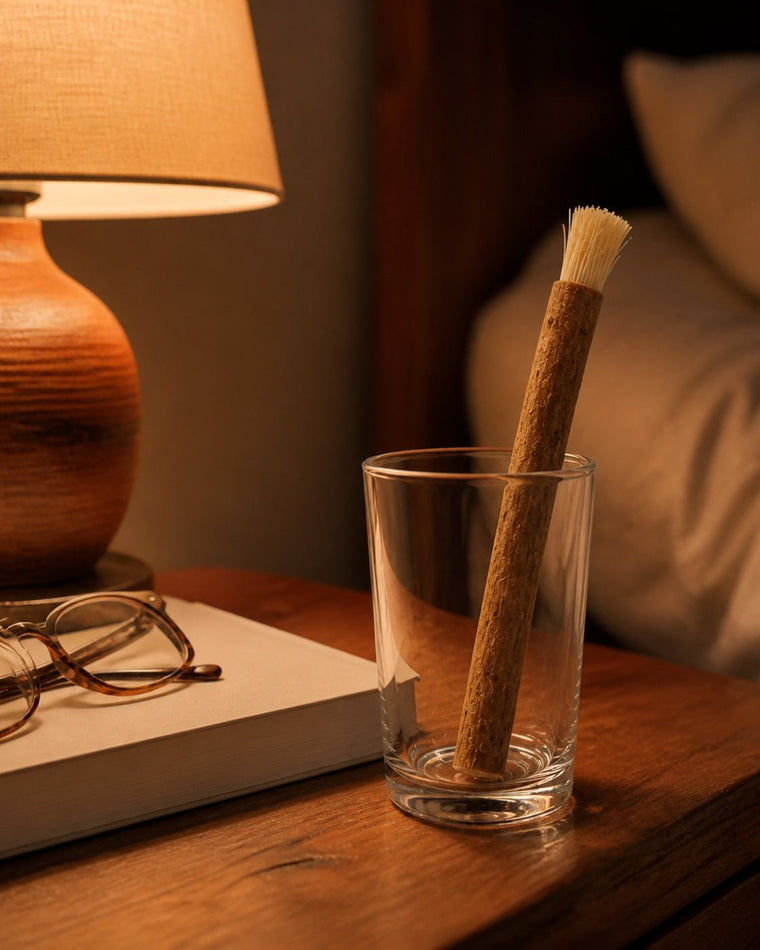
You wake up, and before you have opened your eyes you can taste it: your mouth is dry and sour, and the first thing you want is the glass of water on the nightstand.
If this sounds familiar
- There is a glass of water by the bed, and most mornings it is empty.
- You brushed carefully last night, and by morning it is as if you had not.
- Your tongue feels coated when you wake up, and the coating is there most days.
- Someone has told you that you snore, or you have woken yourself up with it.
- You sleep with a CPAP, and your mouth feels like paper by five in the morning.
- Coffee is the first thing you reach for, partly for the coffee and partly to get rid of the taste.
If three of those are you, you have plenty of company, and you are probably not brushing wrong.
Why this happens more after 50
Your mouth makes far less saliva while you sleep. That is normal at every age. Saliva is the mouth's own rinse. During the day it washes over the teeth and tongue and carries things away. At night the rinse slows to a trickle, and whatever is in your mouth at bedtime stays there for seven or eight hours.
After 50, several things make the night drier still, and none of them is your fault.
Mouth breathing and snoring. Both become more common with age. Air moving over the tongue all night dries it out, and a dry tongue holds on to whatever is on it.
CPAP. Hours of moving air. Even with a humidifier, many people wake up with a dry mouth and a dry throat.
Medications. Blood pressure pills, allergy tablets, antidepressants, bladder medication and many others reduce saliva as a side effect.
Hormones. After menopause, many women notice that their mouth is drier, day and night.
The bedroom itself. Heating in winter and air conditioning in summer both dry the air, and dry air dries the mouth.
The bacteria that live in everyone's mouth keep working through the night, feeding on what is left between the teeth and along the gumline. With little saliva to carry things away, what they produce settles on the teeth and the tongue. That coating is the taste you wake up with.
What most people try, and why it disappoints
- Water by the bed. It helps for the minute it takes to drink it.
- Mouthwash before bed. Most are mostly alcohol, which dries the mouth further. By three in the morning it is long gone and the mouth is drier than before.
- Gum or mints after waking. They cover the taste for twenty minutes. Nothing has been cleaned.
- Brushing harder at night. Sore gums in the morning, and the same dry night.
- Coffee. It washes the taste down for a while, and it is drying, so the taste is back by mid-morning.
- Breath sprays and strips. The same as mints, in a smaller package.
So what can you do?
Think of it as two jobs: what you go to bed with, and what you do first in the morning.
At night, clean thoroughly and gently. Whatever is on your teeth at bedtime sits there until morning with almost no rinse. Take the full two minutes, get along the gumline, and do not skip the tongue. Gently, because gums that will be dry all night are easy to irritate.
In the morning, clean before the coffee. This is where a miswak fits.
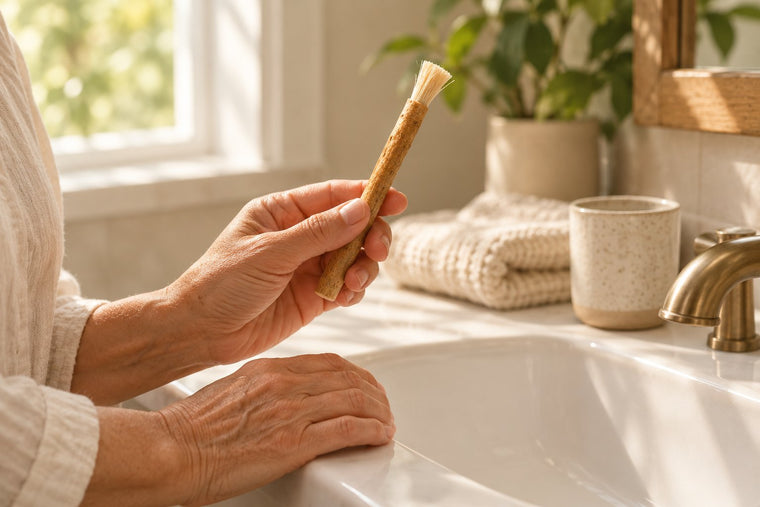
A miswak is a cleaning stick cut from the root of a small tree called Salvadora persica. People in dozens of countries have cleaned their teeth with it for around 7,000 years. You peel about half an inch of bark from one end, chew the tip gently until the fibers separate into a small, soft brush, and brush with it, stick upright, moving up and down away from the gum.
Here is why that suits a dry morning mouth:
Chewing gets saliva going. Preparing the tip means chewing for a moment, and chewing prompts the mouth to make saliva. That is a well-known effect of chewing anything. After a night with almost none, it is exactly what the mouth is missing.
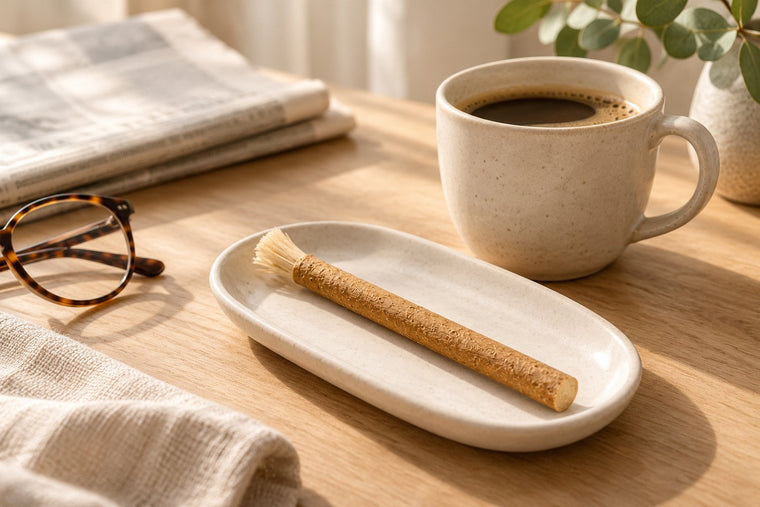
It does not need a sink. You can use it at the kitchen table while the coffee brews, sitting down, before anything else goes in your mouth. You brush the night off first, and the coffee comes second.
The fibers are soft. Gums after a dry night are tender, and soft natural fibers moving up and down do the job without the scraping of worn nylon.
With or without toothpaste. If your dentist wants you on a fluoride toothpaste, keep using it. The stick works alongside it.
It works again at three in the afternoon. If the dry, sour feeling comes back after lunch, the stick is in your purse or on your desk.
There is a body of published research on Salvadora persica. We link the studies on our research page so you can read them yourself. Results vary, and a miswak is not a treatment.

When it is more than a dry night
A bad taste that stays all day, breath that other people notice, or a mouth that feels dry from morning to night are worth a conversation. Sometimes a medication can be adjusted, and that is your doctor's call. Loud snoring together with tiredness during the day is something a doctor should hear about. Gums that bleed or hurt belong to your dentist. If the problem does not go away, talk to your dentist or doctor. A miswak cleans. It does not diagnose.
What it's honestly like
It is a stick. It looks like a twig, about as thick as a pencil and about as long as your hand. The first few days feel odd because there is no handle. After a week or so the grip stops being strange. One stick lasts two to three weeks. It is not a medicine, and it will not change what your sleep or your medications do to your mouth overnight. What it changes is the first five minutes of the morning, and how you spend them.
This article is general information, not medical advice. A miswak is a cleaning tool, not a treatment. If your gums bleed regularly, hurt, or if a problem does not go away, please see your dentist.