The one question to ask before buying another electric toothbrush

You are standing in the drugstore aisle again, looking at a wall of electric toothbrushes, because the last one did not make your gums feel any better. The boxes promise more strokes per minute, more modes, an app. None of them say a word about why your gumline still feels raw.
Before you pick one up, there is one question worth asking: is the problem my gums, or is the problem my brush?
If this sounds familiar
- The buzzing on your lower front teeth makes you wince, so you lift the brush off the gum and hope that still counts.
- There is a drawer with two dead handles, a charger with the wrong plug, and a sleeve of replacement heads you forgot to use.
- You press harder than you should because it feels like the brush is not doing enough, and the pressure light comes on.
- Replacement heads cost more than you remember every time, so you keep the old one a month too long.
If two or three of those are you, the next brush is unlikely to be the answer.
First, to be fair
Some people love their electric toothbrush, and they have good reason. If your hands are stiff or sore, a thick handle that does the moving for you is a real help. For many people an electric brush does a good job, and if yours works for you and your gums feel fine, this article is not asking you to change anything. It is for the person whose gums do not feel fine.
Why this matters more after 50
The gumline has moved. Over decades, gums pull back a little, and the uncovered part of the tooth has no enamel. The gum edge beside it is thin and easily irritated. A head that vibrates thousands of times a minute against that edge is a lot of contact in a sensitive place.
The tissue is thinner. After menopause, gums tend to be drier and more easily irritated. The brush stayed the same while your gums changed, so a brush that felt fine at 40 can feel harsh at 60.
Pressure adds up. Many electric brushes now have a pressure sensor, because people press too hard, especially on a spot that feels like it needs more work. On a receding gumline, pressing is the wrong move, and a powered head makes every ounce of it count more.
None of this is a failing on your part. You were handed a tool built for scrubbing and told to be gentle with it.
What most people try, and why it disappoints
- A newer model. More speed, more modes. The contact with the gumline is the same.
- The "sensitive" head. Softer, and better. It still frays, and the box says to replace it every three months, which few of us manage on time.
- Back to a manual brush. Often a relief for the gums, until the nylon tips flare and the scraping starts again.
So what can you do?
Answer the question honestly. If your gums are the problem, you need the gentlest tool you can find, used every day. More power will not help.
Then look at what an electric toothbrush actually is: a handle, a motor, a battery, a charger, a cord, a head that needs replacing, and a spot on the counter for all of it. On a trip it is a case and an adapter.
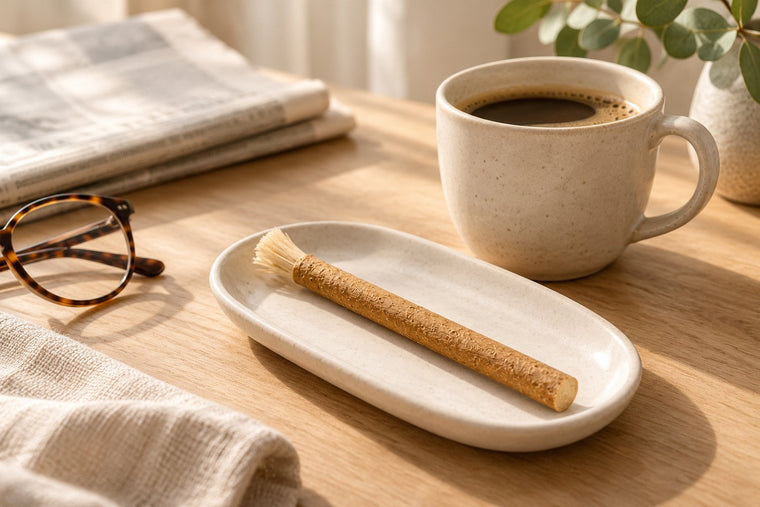
A miswak is a cleaning stick cut from the root of Salvadora persica, a small tree, used for about 7,000 years in many countries, long before anyone put a motor in a toothbrush. You peel about half an inch of bark from one end, chew the tip gently until the wood separates into fine, soft fibers, and brush with those, upright, away from the gum, about two minutes. Every day or two you trim the used end and chew a new one. One stick lasts two to three weeks.
For a person whose gums are the problem, this is a different kind of tool:
Nothing moves except your hand. There is no motor. The fibers reach the gumline at the speed and pressure you choose, and it is hard to press too hard with something as light as a pencil.
The fibers are soft and natural. They bend. They are not cut to a point like nylon, and you never brush with a head that has been fraying for three months, because you chew a new tip every day or two.
One stick replaces brush, head, battery. No charger, no cord, no heads to reorder, nothing to plug in at a hotel. It lives in a purse or a glove box as easily as on the sink.
It works with or without toothpaste. If your dentist has told you to use fluoride, keep using it. A pea of paste on the fibers is all it takes.
Chewing gets saliva going. Opening a new tip means chewing for a moment, and chewing makes the mouth produce saliva. Gums that are often dry tend to be gums that are often sore.
There is a body of published research on Salvadora persica. We link the studies on our research page so you can read them yourself. Results vary, and a miswak is not a treatment.

What it's honestly like
It is a stick. It looks like a twig, because it is one. It is about the thickness of a pencil and about as long as your hand, sealed in a thin plastic sleeve to keep it from drying out. The first few days feel odd, mostly because there is no handle, no head and no buzz, and you will wonder whether it is doing anything. By the end of the first week most people stop wondering. If gripping a pencil is hard for you, start with the three-pack before you commit to more. It is not a medicine, and it will not fix gums that need a dentist. If your gums bleed regularly or hurt, please have them looked at. An electric brush is a fine tool for many people. For a tender gumline, a softer tool used gently every day is the simpler answer.
This article is general information, not medical advice. A miswak is a cleaning tool, not a treatment. If your gums bleed regularly, hurt, or if a problem does not go away, please see your dentist.